Cart
0
You may also like



Educational note: This blog is for information only and should not replace personalised medical advice. If you suspect you may have PMOS, please speak with a qualified healthcare professional and ask for appropriate testing.
For years, so many women were told that the name explained everything: Polycystic Ovary Syndrome.
But here’s the problem. Not everyone with this condition has visible cysts on their ovaries. And not everyone’s symptoms begin with their ovaries either.
Sometimes it looks like acne.
Sometimes it looks like irregular periods.
Sometimes it looks like weight changes that don’t make sense.
Sometimes it looks like exhaustion, anxiety, low mood, cravings, inflammation, fertility struggles or hair thinning that slowly chips away at your confidence.
So many women have been quietly suffering because their symptoms didn’t fit the name.
And for Black women especially, who are already too often dismissed, under-investigated, or told to “just wait and see,” this name change matters.
PMOS stands for Polyendocrine Metabolic Ovarian Syndrome.
In plain English, this new name reflects that the condition is not simply an “ovary issue.” It can involve multiple hormone systems, metabolic health, insulin regulation, skin, reproductive health, mental wellbeing and more.
The Endocrine Society describes PMOS as a condition characterised by hormone fluctuations, with impacts on weight, metabolic and mental health, skin and the reproductive system. It also notes that the old name reduced a complex hormonal condition to a misunderstanding about “cysts,” which contributed to missed diagnoses and inadequate treatment. 1
This is why the name change feels so important. It gives language to what many women already knew in their bodies:
“This is bigger than cysts.”
The phrase “polycystic ovaries” made many people focus on the wrong thing.
It created the impression that cysts were the central feature of the condition. So if someone had symptoms but did not have obvious ovarian cysts on a scan, they could be left confused, dismissed, or told they didn’t “fit” the picture.
But PMOS has always been more complex than that.
It can show up through:
And this is where so many women have fallen through the cracks.
They were not imagining symptoms. Their body was speaking. But the name was too small to hold the full story.
Yes. This is one of the most important things to understand.
The 2023 International Evidence-based Guideline for PCOS stated that in adults, diagnosis is based on identifying at least two key features: clinical or biochemical hyperandrogenism, ovulatory dysfunction, and/or polycystic ovaries on ultrasound or elevated AMH, after other causes have been excluded. It also states that where irregular cycles and hyperandrogenism are present, ultrasound or AMH is not required for diagnosis. 2
In normal words: a scan is not always the full story.
This is why the new name matters. It moves the conversation away from “Do you have cysts?” and towards “What is happening hormonally, metabolically and across the whole body?”
This is the question so many of us are asking.
The honest answer is: not automatically.
A name change alone will not fix years of medical dismissal, short appointments, lack of training, health inequalities or the emotional exhaustion of having to advocate for yourself again and again.
But it is a step in the right direction.
A large international study found that nearly half of participants saw three or more healthcare professionals before receiving a PCOS diagnosis, and for one-third of participants, diagnosis took more than two years. 3
So yes, this name change matters — but only if it is followed by better education, better clinical awareness, better testing pathways and doctors who understand the condition beyond outdated assumptions.
PMOS gives us a better starting point. It gives us better language. And sometimes better language is the first step towards better care.
For our community, this is the part we cannot ignore.
Many women discover something is wrong not because of a diagnosis, but because of their hair.
Their edges start thinning.
Their parting looks wider.
Their wash day shedding feels heavier.
The crown area starts looking sparse.
And emotionally, it can feel terrifying.
Hair is never “just hair” for Black women. It is identity, expression, memory, confidence, culture and care. So when your hair starts changing and no one can explain why, it can feel deeply unsettling.
PMOS can contribute to hair concerns because hormonal imbalance and androgen sensitivity may affect the hair growth cycle. In some people, higher androgen activity can contribute to pattern thinning, especially around the crown, temples or parting area.
This is why we always say: you cannot always oil your way out of a hormonal issue.
If your hair loss is connected to PMOS, low iron, thyroid imbalance, stress, postpartum changes, inflammation or insulin resistance, you need to look at the root picture.
That means scalp care matters, but so does what is happening internally.
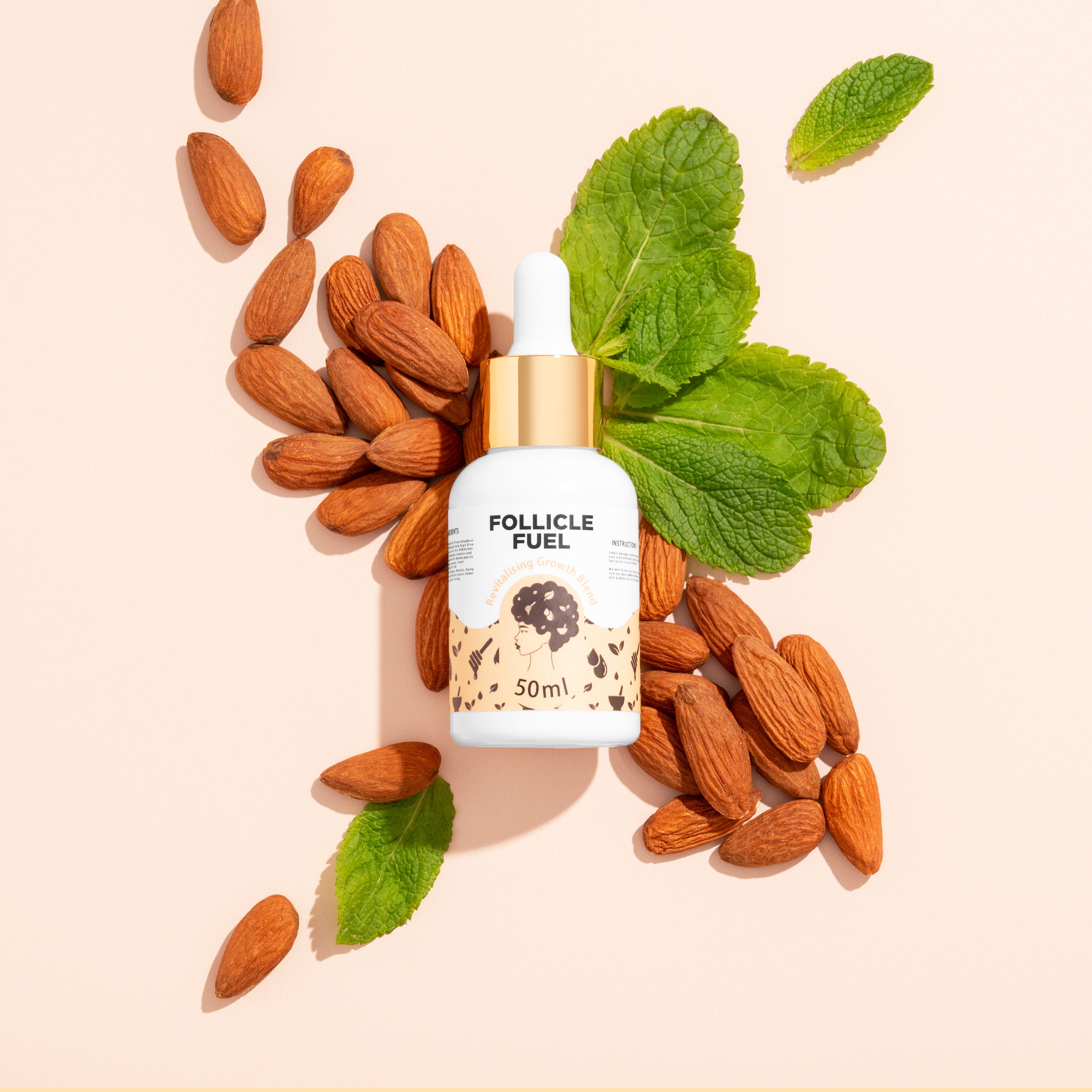
Follicle Fuel Pro+ was created for women dealing with more stubborn, severe or hormone-related thinning — especially when the scalp needs targeted support alongside a deeper inside-out approach.
It is our most advanced scalp oil, formulated with a potent blend of botanical oils and growth-supporting ingredients chosen to help nourish the scalp, support circulation through massage, and care for areas affected by thinning, weak edges or slow regrowth.
We often describe it as our DHT-blocking scalp oil because it is designed for women whose hair concerns may be linked to androgen sensitivity, thinning around the crown, hormonal changes or more persistent shedding patterns.
But here is the truth we will always stand by:
Follicle Fuel Pro+ is not a replacement for diagnosis, blood work, medical treatment or investigating what your body is trying to tell you.
It is a powerful part of a routine — not the whole answer.
For best results, we recommend using it consistently alongside:
If your hair has been trying to tell you something, listen to it. But also look deeper.
If you have symptoms and feel dismissed, it can help to go into your appointment prepared.
You may want to ask about:
And if your main concern is hair thinning, say that clearly.
Not “my hair is annoying me.”
Say: “I am experiencing hair thinning and I would like to investigate whether hormones, iron, thyroid, PMOS or androgen sensitivity could be contributing.”
Sometimes the way we frame the concern changes how seriously it is investigated.
Yes. But it is not the finish line.
This new name does not erase the years women spent being told they were dramatic, lazy, too stressed, too overweight, too anxious, too sensitive or too difficult.
It does not instantly fix diagnosis delays.
It does not guarantee every doctor will suddenly understand the condition properly.
But it does do something important.
It says the old name was not enough.
It says cysts were never the whole story.
It says the body-wide impact matters.
It says the metabolic picture matters.
It says the hormonal picture matters.
It says the woman sitting in the appointment room, trying to explain symptoms that do not fit neatly into one box, deserves to be taken seriously.
If you have been losing hair and blaming yourself, this is your reminder:
You were not being dramatic.
If your periods have been irregular and you were told to “come back later,” you were not being difficult.
If your skin, mood, weight, energy and hair all changed and no one connected the dots, you were not imagining it.
Your body was speaking.
And maybe now the medical language is finally starting to catch up.
If you are dealing with thinning, shedding, weak edges or hormone-related hair concerns, Follicle Fuel Pro+ was created to support your scalp care routine while you take the deeper steps your body may need.
Use it as part of a consistent, gentle routine — especially on areas where you are noticing thinning, slow growth or scalp weakness.
Because your hair journey should not be built on guessing.
It should be built on understanding.
